
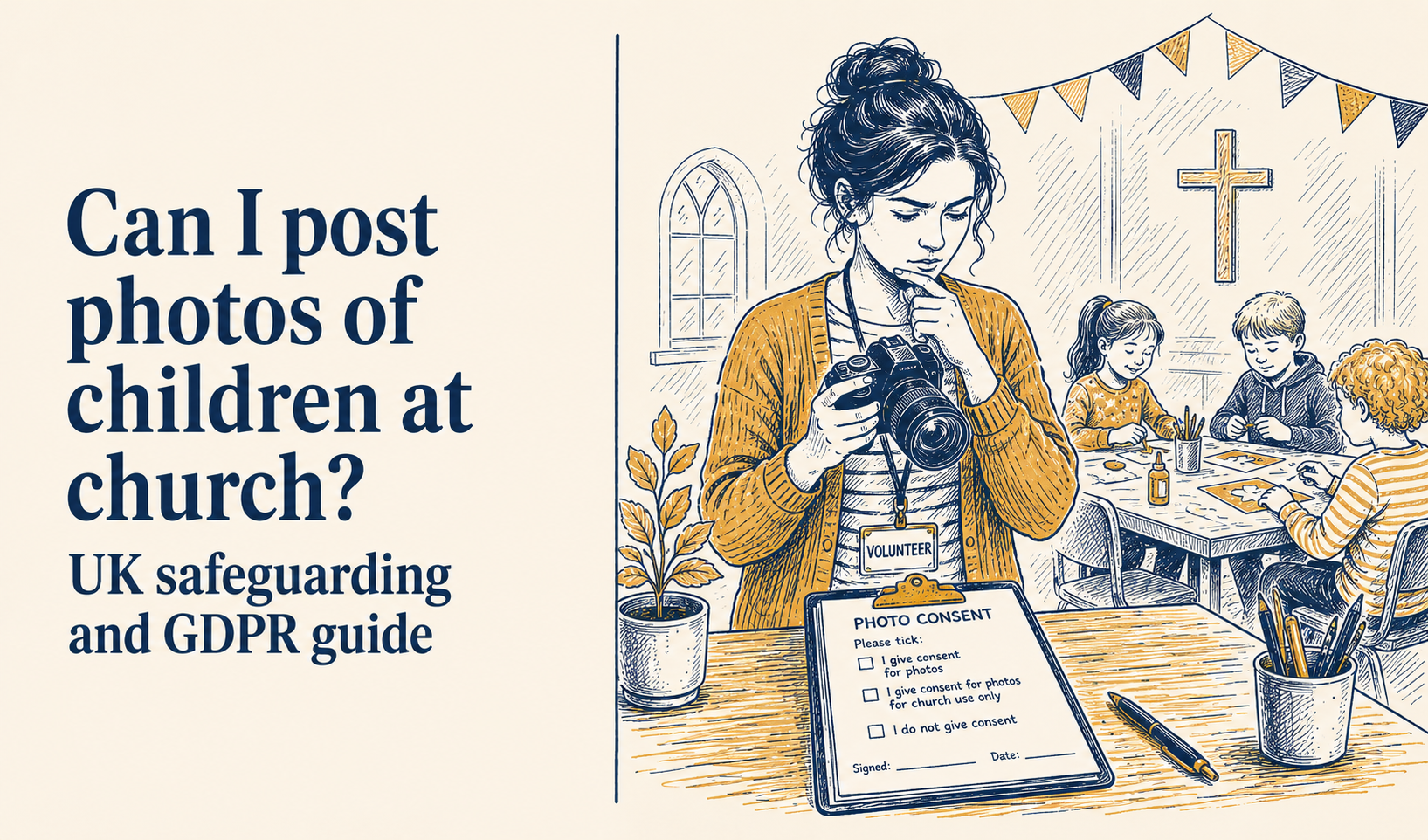
Can I post photos of children at church? UK safeguarding and GDPR guide
The short answer is: yes, with proper consent in place.
The longer answer is that posting photos of children on church social media requires explicit written consent from a parent or guardian, a clear policy for how those photos are used, and a system for knowing whose consent you do and do not have before you pick up a camera at a church event.
This guide covers what the rules actually require, how to set up a consent system that works in practice, and what to do when you are not sure.
Why this matters more for children than adults
UK GDPR and safeguarding guidance treat children differently from adults when it comes to photography and social media, for good reason. Children cannot give meaningful legal consent themselves (the age threshold under UK GDPR for processing children’s data without parental consent is 13 for online services, but in practice most churches seek parental consent for all under-18s). They may not understand the implications of having their image posted publicly online. And once an image is published online it can be difficult or impossible to fully remove.
Safeguarding considerations go beyond GDPR. The statutory guidance Keeping Children Safe in Education and the voluntary sector equivalent frameworks emphasise that images of children should not be shared in ways that could make them identifiable to people outside their community without appropriate consent.
Your church’s safeguarding lead (every church should have one) should be involved in any conversation about photography policy for activities involving children.
What you need to have in place
A photography consent form. A written form that parents or guardians sign, giving consent for their child to be photographed and for those photos to be used in specified ways. The form should be specific about where photos may be used: the church Facebook page, the church website, printed materials, the church newsletter. Do not use vague language like “church communications” - parents need to know exactly what they are consenting to.
A record of who has and has not consented. This is the practical challenge. You need to know, before you post a photo from Sunday’s children’s work, which children in that photo have consented parents and which do not. This means keeping consent records somewhere accessible - a spreadsheet, your ChurchSuite records, or a folder of signed forms - and checking them before you post.
A clear process for new families. Every family that starts attending church activities with their children should be given a consent form within their first few weeks. If your church uses ChurchSuite, consent status can be recorded against individual family records which makes checking significantly easier.
A named person responsible. Someone should be clearly responsible for managing photography consent at your church. This does not need to be a paid role - it can be the children’s workers, the safeguarding lead, or the social media volunteer - but it should be one person, not everyone and therefore no one.
What consent needs to include
A photography consent form for church use should cover:
The name of the child and their parent or guardian. Which activities the consent covers (Sunday school, youth group, toddler group, holiday club and so on - be specific). Where photos may be used (list each platform and publication). Whether photos may be shared with partner organisations (other churches, denominational newsletters) or used in press coverage. The right to withdraw consent at any time. A contact name and email for queries or withdrawal requests.
It does not need to be a long document. Half a side of A4 covers everything needed. Clarity matters more than comprehensiveness.
In practice: what to do at an event
Before any event where you plan to take photos, check your consent records for the children who will be attending. Know who has consented and who has not before you arrive with a camera.
During the event: only photograph children whose consent is confirmed. If you are not sure whether a particular child has consented, do not photograph them rather than checking later. It is much easier to not take a photo than to remove one after it has been posted.
After the event: before posting, check each photo against your consent records. If a non-consented child is in a photo, do not post it even if they are not the focus of the image. If they appear in the background and are not identifiable, use your judgement - but err on the side of caution.
When you do not have a consent system yet
If your church has been posting photos of children without a formal consent system in place, the right thing to do is not to panic but to take action promptly.
First, stop posting new photos of children until consent forms are in place. Second, review photos already posted and consider removing any where consent was not obtained. Third, get consent forms completed as quickly as possible for all families with children attending church activities. Fourth, talk to your safeguarding lead about what has happened and what steps you are taking.
Most churches that have not had a proper consent system have not been acting maliciously. But the remedy is straightforward and worth prioritising.
Photos that do not require individual consent
Wide-angle shots of a large group at a public event, where no individual child is identifiable, carry less risk than close-up photos of individual children. A photo of a hundred people at a Harvest festival where children are present but not the focus is different from a portrait of a named child at Sunday school.
That said, the safest approach for any photo that includes children is to check consent rather than to make judgement calls about identifiability. What looks non-identifiable to you may be immediately recognisable to someone who knows the child.
Social media and safeguarding: the wider picture
Photography consent is one part of a broader digital safeguarding picture for churches that work with children. Other considerations include: who can message children through your church’s social media accounts, how you handle online communication between adults and young people, and whether your church has a digital safeguarding policy as well as a general safeguarding policy.
These questions go beyond the scope of this post, but your safeguarding lead and your denomination’s safeguarding resources are the right places to start. The thirtyone:eight organisation (formerly CCPAS) provides safeguarding training and resources specifically for UK churches and is worth knowing about if your church does not already use their resources.
For the practical GDPR framework that sits alongside safeguarding, see GDPR and church social media: complete guide for UK churches. For setting up a photography consent form and social media policy, see church photo consent and GDPR and church social media policy template UK.
ChurchReach is built for UK church volunteers managing social media responsibly. Start a free trial at churchreach.co.uk.