
Harvest Festival social media post ideas for UK churches
Harvest Festival sits in a particular place in English church life. It is one of the occasions that people who do not regularly attend church still associate with churches, often because of memories of primary school harvest assemblies or bringing tins to a church collection as a child. That cultural familiarity is an asset for your social media: Harvest content reaches people who are not your regular congregation, because the occasion itself is something they already have a feeling about.
This guide covers what to post, when to start posting it, and how to make the most of an occasion that most US-focused church social media tools simply do not have in their template library.
When to start posting
Earlier than you think. Searches for Harvest Festival content - services, events, what to bring, local church harvest suppers - start climbing in late August and peak in the first two weeks of October.
Your first Harvest post should go out in the second or third week of September, which gives it time to be indexed and seen before the season peaks. If you wait until the week before your Harvest service, you have missed the window for reaching people who are actively searching.
A simple schedule that works for most UK churches:
Mid-September: announce your Harvest service with date, time and any practical details (is there a food bank collection? should people bring donations?)
Late September: a reminder post, possibly with a photo of the church being decorated or prepared
The week before: final reminder with clear practical information
The day before or morning of: a warm invitation post
After the service: a photo from the service and a note of thanks
What to post
The service announcement. Clear and practical. Date, time, location, whether there is a food bank collection or a specific donation request. Many people attend Harvest services who do not come on a regular Sunday - make the entry point as low-friction as possible. “All are welcome” should be in the post, not assumed.
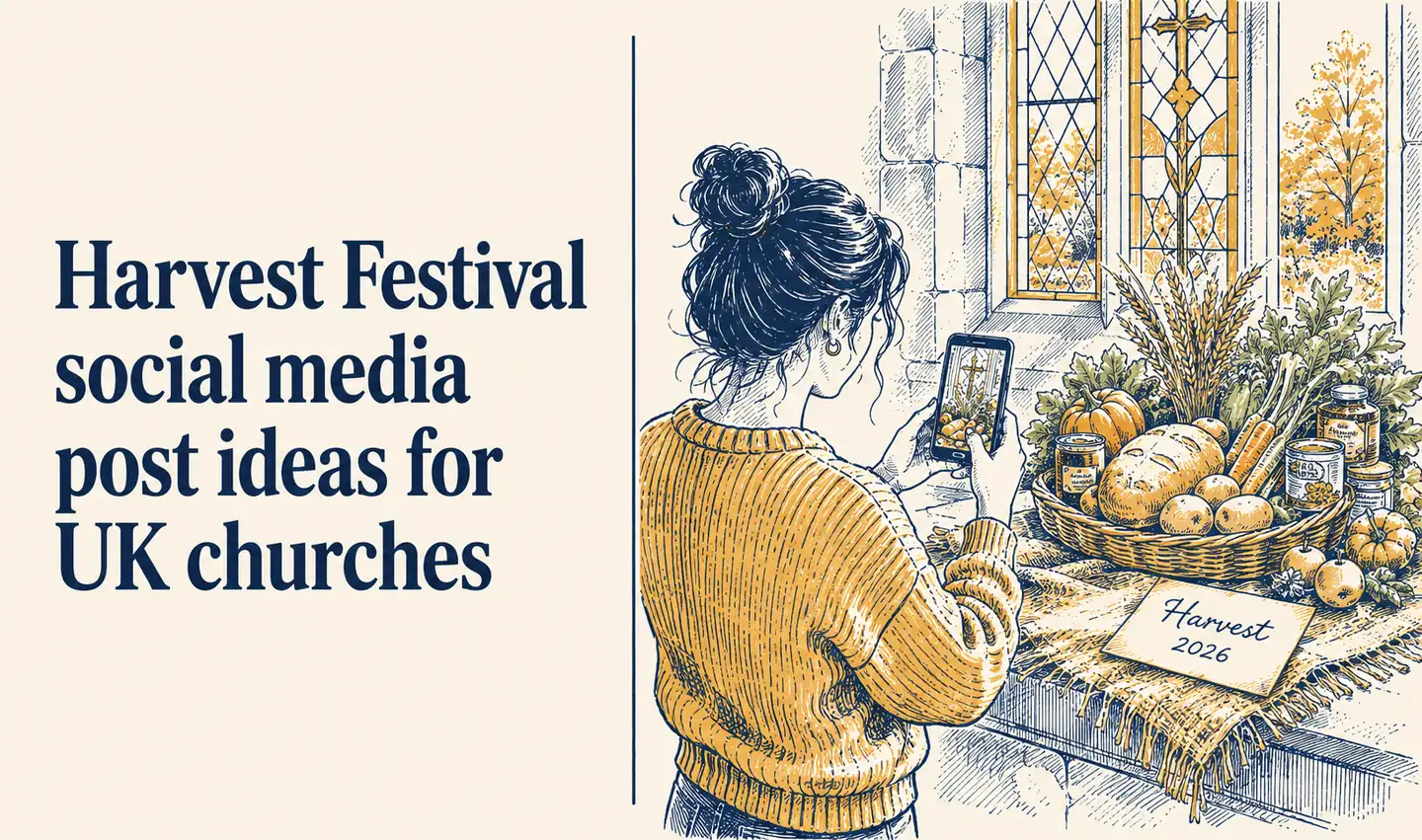
The harvest display. A photo of your church’s harvest display - vegetables, tins, bread, flowers arranged on the windowsill or around the altar - is one of the most consistently shareable pieces of Harvest content a church can post. It looks beautiful, it is specific to your church, and it connects the occasion to something real and visual. Take this photo as soon as the display is set up and post it promptly.
The food bank connection. If your Harvest collection is going to a food bank or community organisation, name them. “All donations this Harvest will go to [name of food bank] in [town]” is a more compelling post than a generic reference to those in need. People respond to specificity. If you know how many families or individuals the food bank serves, include that too.
A reflection on thankfulness. A short post on the theme of Harvest - gratitude, provision, the connection between faith and the physical world - performs well in the week leading up to the service. Keep it brief and personal rather than instructional.
Bible verses suited to Harvest. A few that work well: Psalm 65:9-11, Deuteronomy 8:7-10, 2 Corinthians 9:10-11, Matthew 9:37-38. A verse with two sentences of reflection is enough. See the best tools for creating church social media graphics for how to format these quickly.
The harvest supper or community event. If your church runs a Harvest supper or a community meal alongside the service, treat it as a separate post rather than adding it to the service announcement. Events that involve food and community tend to reach beyond the regular congregation, particularly when shared by congregation members who have friends or neighbours they want to invite.
After the service. A photo from the service, a note of thanks to everyone who came and contributed, and if possible a brief mention of how much was donated and where it is going. Closing the loop on the Harvest collection - “we collected 47 bags of food for [food bank name]” - is the kind of specific, real content that people share and remember.
Tone
Harvest Festival content works best when it is warm and community-facing rather than exclusively inward. The occasion has natural outreach energy - people who do not usually engage with your church’s social media will stop scrolling for a Harvest display photo or a post about a community food collection in a way they might not for a Sunday service announcement.
Avoid making Harvest posts feel like a church-internal communication that outsiders are allowed to observe. Write as if you are inviting the whole community, because you are.
A note on Harvest and food poverty
Many UK churches connect their Harvest Festival directly to food bank support, and this is worth being explicit and specific about on social media. Naming the food bank, stating the need, and showing the outcome (photos of donations) gives Harvest content a genuine purpose beyond tradition.
Be careful not to be sensationalist or to present poverty in a way that strips dignity from the people being helped. “We are collecting for [food bank name] who support families across [area]” is appropriate. Graphic descriptions of deprivation are not.
Scheduling in advance
Harvest Festival is one of the occasions most worth scheduling in advance. If you write and schedule your Harvest posts in July or August - including the post-service photo slot as a blank reminder - you will not be scrambling in September when the season arrives alongside everything else autumn brings.
For how to approach seasonal content planning, see how to schedule church social media posts and church social media content calendar.
ChurchReach has Harvest Festival templates built for UK churches. Start a free trial at churchreach.co.uk.