
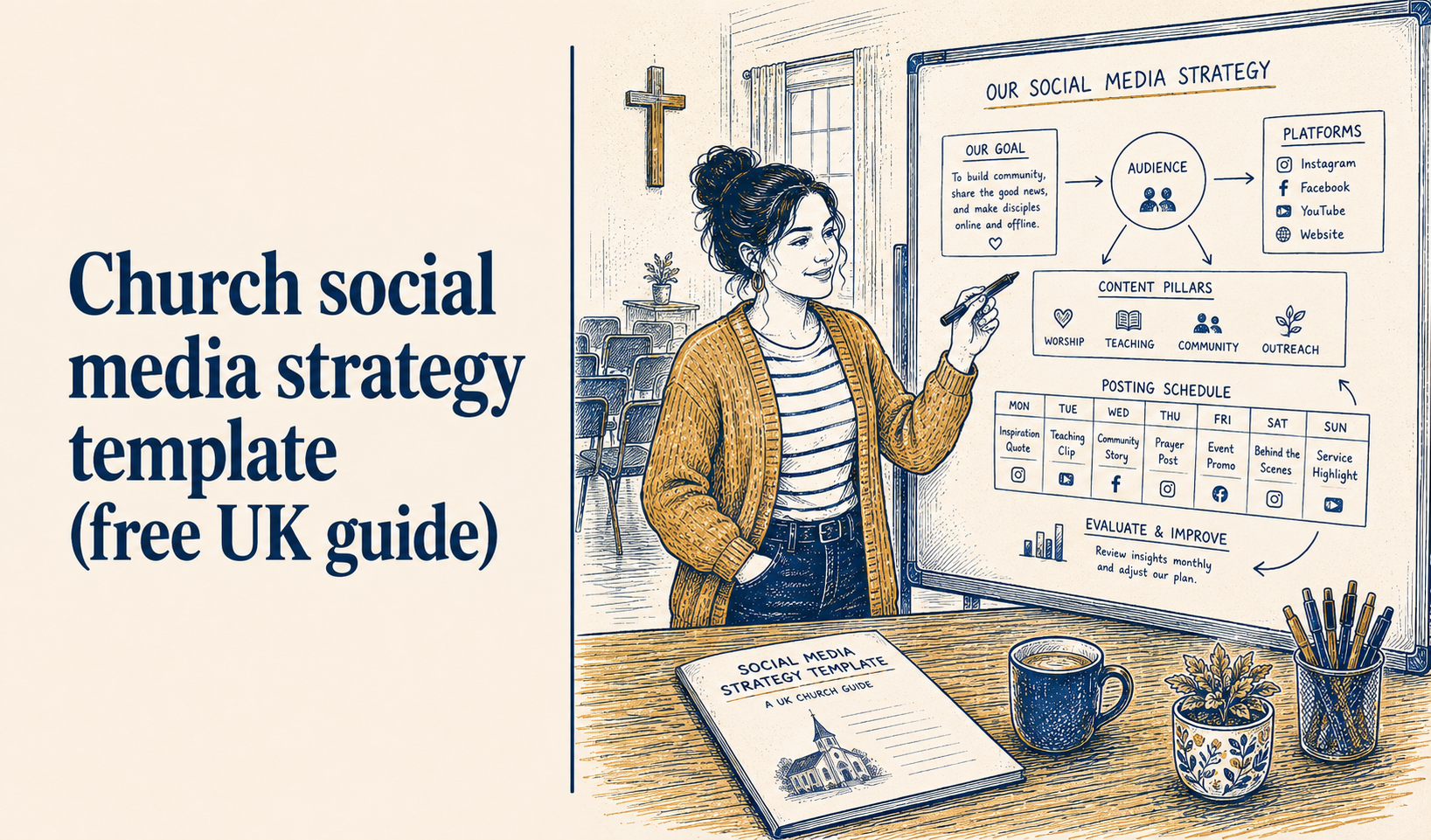
Church social media strategy template (free UK guide)
Most church social media volunteers do not have a strategy. They have a habit: post when something is happening, go quiet when it is not, occasionally feel guilty about not posting more, repeat.
That is not a criticism. It is the natural result of managing social media as one task among many, with no dedicated time and no clear brief. A strategy sounds like something a marketing department produces. Most church volunteers do not see themselves as marketers and do not want to.
But a strategy does not have to be complicated. For a church social media volunteer, a strategy is just a short document that answers three questions: what are we trying to achieve, what will we post, and how often. That is genuinely all it needs to be. And having those three things written down and agreed with your pastor or leadership team makes the weekly work of managing social media significantly easier, because you are no longer making all the decisions alone.
This guide walks through what to include and ends with a template structure you can fill in today.
What a church social media strategy is not
Before getting into what a strategy should include, it is worth clearing up what it is not.
It is not a content calendar. A calendar is a schedule of specific posts. A strategy is the thinking behind why you are posting and what you are trying to achieve. The strategy comes first and the calendar flows from it.
It is not the same as a social media policy. A policy covers who can post, what requires approval, and how to handle difficult situations. A strategy covers what you are trying to achieve and how you plan to achieve it. Both are useful and they work together, but they are different documents. See our guide to church social media policy templates if you need both.
It is not a commitment to posting more than you can sustain. A strategy that commits to daily posts when you have one volunteer with half an hour a week is not a strategy, it is a recipe for burnout and an abandoned account. A realistic strategy that commits to three posts a week and delivers them consistently is more valuable than an ambitious one that falls apart in the first month.
The three questions your strategy needs to answer
1. What are we trying to achieve?
Be specific. “Have a good social media presence” is not an objective. “Make it easy for people in our area to find out when our services are and feel welcomed before they visit” is an objective. “Serve our congregation by keeping them informed about what is happening at the church” is an objective.
Most UK churches have two genuine goals from social media: keeping existing congregation members connected and informed, and being visible and welcoming to people in their local community who might be looking for a church. Write both down. Every decision about what to post should serve one of those two purposes.
2. What will we post?
Your strategy should define the types of content you will produce regularly, not the specific posts themselves. A simple content mix for most UK churches looks something like this: service information and any changes, event announcements, photos from services and events, Bible verses or short reflections, seasonal content around the church calendar.
You might also want to include: sermon quotes or clips if your church records services, community news and partnerships, pastoral moments that the congregation has consented to sharing.
What you probably do not need: content about church news outside your own congregation, political commentary, shared posts from national organisations, or anything that requires significant research or production time.
3. How often will we post?
Be honest about this. If you have an hour a week to spend on social media, three posts a week is achievable. If you have fifteen minutes, two posts a week is achievable. Write down a number you are confident you can hit consistently, not the number you wish you could post.
Consistency matters more than frequency on social media. An account that posts three times a week every week looks more active and trustworthy than one that posts fifteen times in one week and then nothing for three weeks.
For a more detailed guide to scheduling and batching your content, see our post on how to schedule church social media posts.
Getting your strategy agreed
A strategy that only you know about is not much use. It needs to be agreed with your pastor or leadership team, for two reasons.
The first is practical: you need to know that the people in authority over you have signed off on what you are doing. If your strategy says you will post photos from Sunday services, and the pastor later decides he does not want photos posted without his approval, you have a conflict that should have been resolved before you started. A strategy conversation surfaces these questions before they become problems.
The second is protective: having an agreed strategy means that when you make a decision about what to post (or not post), you can point to the document. You are not making a personal judgement call, you are following an agreed approach.
Bring a draft to a leadership meeting, walk through it briefly, invite any changes, and note that it was agreed. That is all the process it needs.
Reviewing your strategy
Once agreed, your strategy does not need to be revisited constantly. A review every six months or so is enough for most churches, or when something significant changes: a new platform, a new volunteer taking over the accounts, a major change in the church’s direction or programming.
The review does not need to be formal. A thirty-minute conversation that ends with any changes noted is sufficient.
The template
Here is a structure you can fill in. Copy it into a document, fill in the bracketed sections, share it with your leadership team, and you have a strategy.
[Church name] Social Media Strategy
Agreed by: [name, role] Date agreed: [date] Next review: [date, suggest 6 months from now]
Our goals
We use social media to:
- Keep our congregation informed about services, events and church life
- Be visible and welcoming to people in [your town/area] who might be looking for a church community
Platforms
We currently use: [list platforms and account names] The person responsible for each account: [name(s)]
What we post
Our regular content includes:
- Service times and any changes
- Event announcements (one week before + day before reminder)
- Photos from services and events (with consent - see our photography policy)
- Bible verses and short reflections
- Seasonal content around the church calendar
- [Any other types specific to your church]
Content that requires approval from [pastor/named leader] before posting:
- Anything relating to pastoral situations
- Anything that might be controversial or sensitive
- [Any other categories relevant to your church]
How often we post
We aim to post [number] times per week across [platforms]. We batch and schedule content on [day of week] for the week ahead.
Our voice
We communicate in a way that is [two or three words that describe your church’s tone - e.g. warm and welcoming / thoughtful and honest / enthusiastic and informal]. We avoid [anything specific to avoid - e.g. jargon, overly formal language, US church terminology].
Seasonal content
We plan social media content around the UK church calendar. Key occasions we mark each year include: [list the occasions relevant to your church - Harvest, Remembrance, Advent, Christmas, Lent, Easter etc.]. We aim to plan seasonal content [number] weeks ahead. See the UK church calendar guide for post ideas for each occasion.
Reviewing this document
This strategy will be reviewed on [date]. Any changes will be agreed with [name/role] and this document updated.
That is a complete strategy. It fits on one page, it takes less than an hour to fill in, and it is immediately useful to anyone who manages your church’s social media now or in the future.
ChurchReach was built to work alongside a strategy like this: scheduling, templates for UK occasions, and AI captions that match your church’s voice. Start a free trial at churchreach.co.uk.