
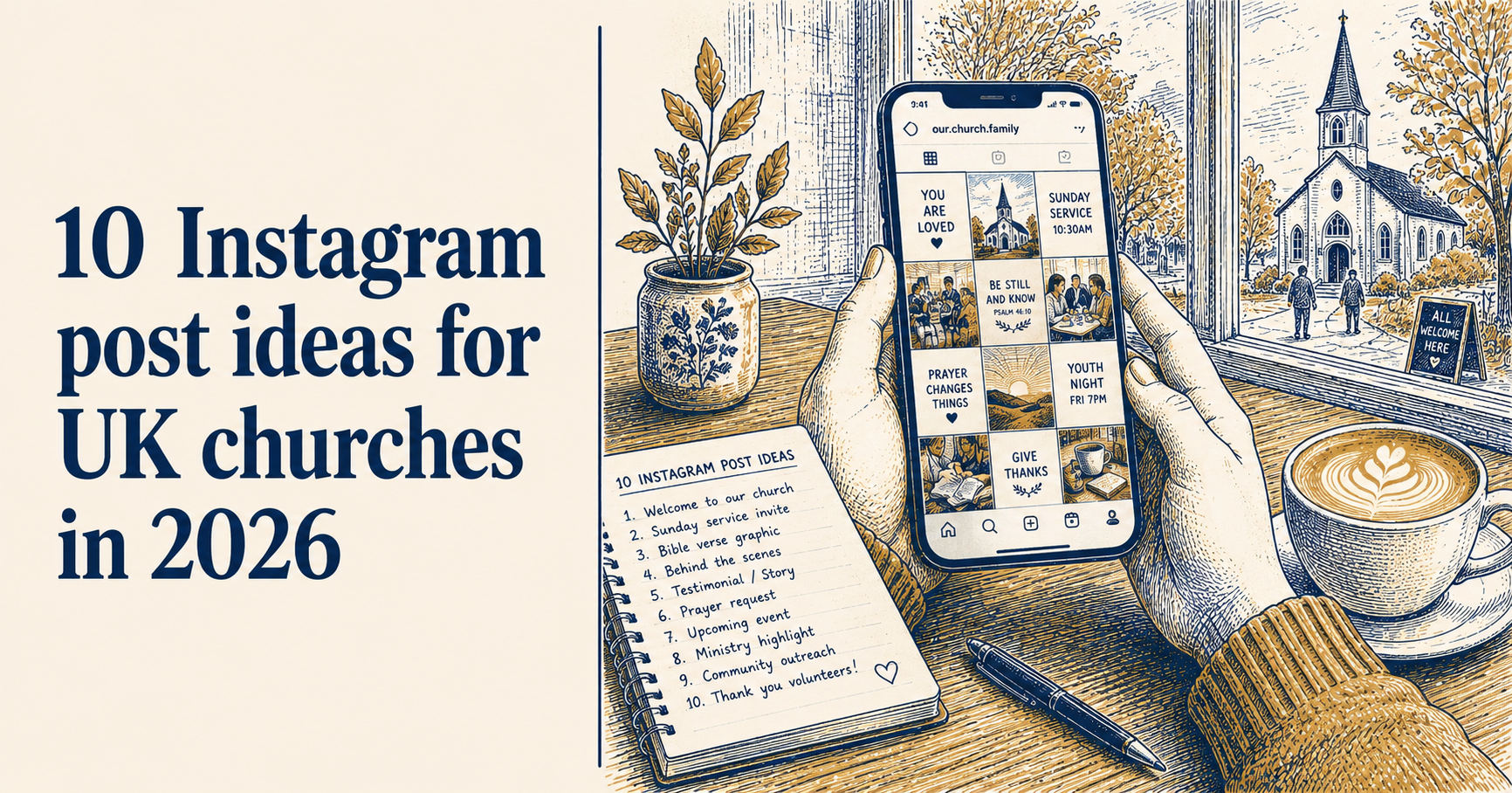
10 Instagram post ideas for UK churches in 2026
Instagram is not the most important platform for most UK churches. That is Facebook, and it probably will be for a while yet. But Instagram is worth being on, particularly if your church has families with children, young adults, or anyone under 40 who might be looking for a church community.
The challenge is that Instagram rewards visual content and consistency in a way that Facebook does not. A church Facebook page can survive a mix of text posts, shared links and occasional photos. An Instagram account that does not have a clear visual identity tends to look neglected rather than just casual.
The good news is that you do not need a design team or a daily posting schedule to run a decent church Instagram account. You need a few reliable types of content and a consistent approach to how they look. These ten ideas cover the content that tends to perform well for UK congregations, with some notes on how to approach each one.
1. Sunday service recap photos
A genuine photo from Sunday morning is consistently the best-performing content type for church Instagram accounts. Not a staged shot before anyone arrives. Not a stock image. A real photo of real people in your church, taken during or immediately after a service.
These posts work because they show prospective visitors what your church actually looks like. A photo of forty people singing in a Victorian hall in Wolverhampton tells someone more about your congregation than any amount of written description.
Caption approach: keep it brief. The date, a line about the morning, maybe a phrase from the sermon if one stuck with you. Two or three sentences at most.
2. Bible verse graphics
Bible verse posts are reliable performers on church Instagram, particularly when they are visually simple and the verse is chosen with some thought rather than selected at random.
The verses that tend to get saved and shared are the ones that feel genuinely applicable to ordinary life rather than specifically churchy. Isaiah 40:31 on a Monday morning reaches people differently from a verse about temple worship.
Keep the graphic clean: one verse, a simple background, your church’s font and colours. Resist the urge to add multiple verses, a long reference, and a paragraph of commentary. Let the verse do the work. ChurchReach has a Bible verse picker built into the editor that pulls directly from multiple translations including NIV Anglicised, which saves the copy-and-paste step.
3. Behind the scenes
Photos and short videos that show what happens behind the public face of church life consistently generate strong engagement because they feel genuine rather than produced. The team setting up chairs on a Saturday morning. Someone arranging flowers for a wedding. The sound desk during a rehearsal. The kitchen volunteers making tea after a service.
These posts work because they make your congregation feel included and give outsiders a sense of the community behind the services. They require almost no planning: just take out your phone when you notice something worth showing.
4. Quotes from the sermon
A short quote from Sunday’s sermon, set against a simple graphic, is one of the most shareable content types a church can post. It extends the reach of the sermon beyond the people who were in the room, and it gives people a reason to share the post with someone they think needs to hear it.
The quote needs to be genuinely quotable: punchy, self-contained, surprising or honest enough to land without context. A theological nuance that only makes sense in the context of the full sermon will not work as a standalone post. Something that reads as a complete thought in one or two sentences will.
If your church records its sermons and uploads them to YouTube, this pairs naturally with a link to the full sermon in your bio. See our guide on managing church social media as a volunteer for more on weaving sermon content into your regular posting rhythm.
5. Event announcements
Instagram is not ideal for detailed event information because you cannot include clickable links in captions. But it is useful for visual event promotion: a simple graphic with the key details (what, when, where), posted a week before the event and again the day before as a reminder.
Keep the graphic uncluttered. Event, date, time. If people need more information, tell them to find the link in your bio or message you directly. Do not try to fit everything onto the graphic.
For help creating clean event graphics quickly, see the best tools for church social media graphics.
6. Community moments
Photos from community events - a Harvest supper, a toddler group session, a summer fair, a community meal - perform well because they show your church as rooted in a real place and engaged with real people rather than existing only for Sunday services.
These posts are also some of the easiest to produce. Take your phone to any church event and take ten photos. Three or four of them will be worth posting.
The caption can be simple: what the event was, who came, one genuine observation about it. “We had forty families at our summer fair yesterday, including several we hadn’t met before. Good afternoon.” That is enough.
7. Seasonal graphics
The UK church calendar gives you a predictable set of occasions worth marking on Instagram every year: Harvest Festival, Remembrance Sunday, Advent, Christmas, Lent, Easter, Mothering Sunday, Pentecost. A simple graphic acknowledging each one, posted on or just before the day, keeps your account active through quieter periods and connects your church to the wider rhythm of the year.
These do not need to be elaborate. A clean graphic with the name of the occasion and a short line is enough. ChurchReach has templates for UK church occasions including Harvest, Remembrance and Advent built into the library, which means you are not starting from a blank canvas each time.
8. Congregational milestones
Baptisms, dedications, milestone anniversaries of people in the congregation, significant giving moments, new staff or volunteers joining the team: these are moments worth marking publicly, with the consent of the people involved.
These posts tend to generate the most comments of anything a church posts on Instagram, because they are personal and because people who know the individuals involved will want to respond. They also show your church as a place where real life is celebrated.
Always get explicit consent before posting anything in this category. A quick message asking “would you be happy for us to share this?” takes thirty seconds and is always worth doing.
9. Questions and polls
Instagram Stories are a good format for simple engagement: a poll, a question sticker, a countdown to an event. They reach your followers without requiring them to comment publicly, which suits some people better than a post comment.
A simple question in Stories - “What is your favourite Christmas carol?” the week before Advent, or “What is one thing you are grateful for this week?” - takes two minutes to post and typically generates a higher response rate than a feed post asking the same question.
Stories disappear after 24 hours, which makes them lower-stakes to post than feed content. Use them for timely, lightweight content that does not need to live on your profile permanently.
10. A look back
Occasional throwback posts, particularly for significant anniversaries, tend to perform well because they give long-standing congregation members something to respond to and give newer members a sense of the church’s history.
A photo from your church’s founding, a major event from ten years ago, a photo of a building before renovation: these posts tend to generate comments from people who remember being there, which extends their reach organically.
You do not need a deep archive to do this. Even a photo from three or four years ago counts. If your church has been around for decades, the local library or a long-standing member may have photos worth digitising.
Keeping it consistent
The thing that makes Instagram work for a church over time is not posting frequency or follower count. It is consistency of visual style. A grid where every post looks like it belongs to the same organisation, with the same fonts and colour palette applied across different types of content, looks intentional and trustworthy.
If you are not sure where to start with a consistent look, the best tools for church social media graphics covers the practical options for UK church volunteers, including tools that let you save your church’s branding and apply it across every graphic without starting from scratch each time.
ChurchReach has templates for all ten of these content types, built for UK church occasions and ready to edit with your church’s details. Start a free trial at churchreach.co.uk.