
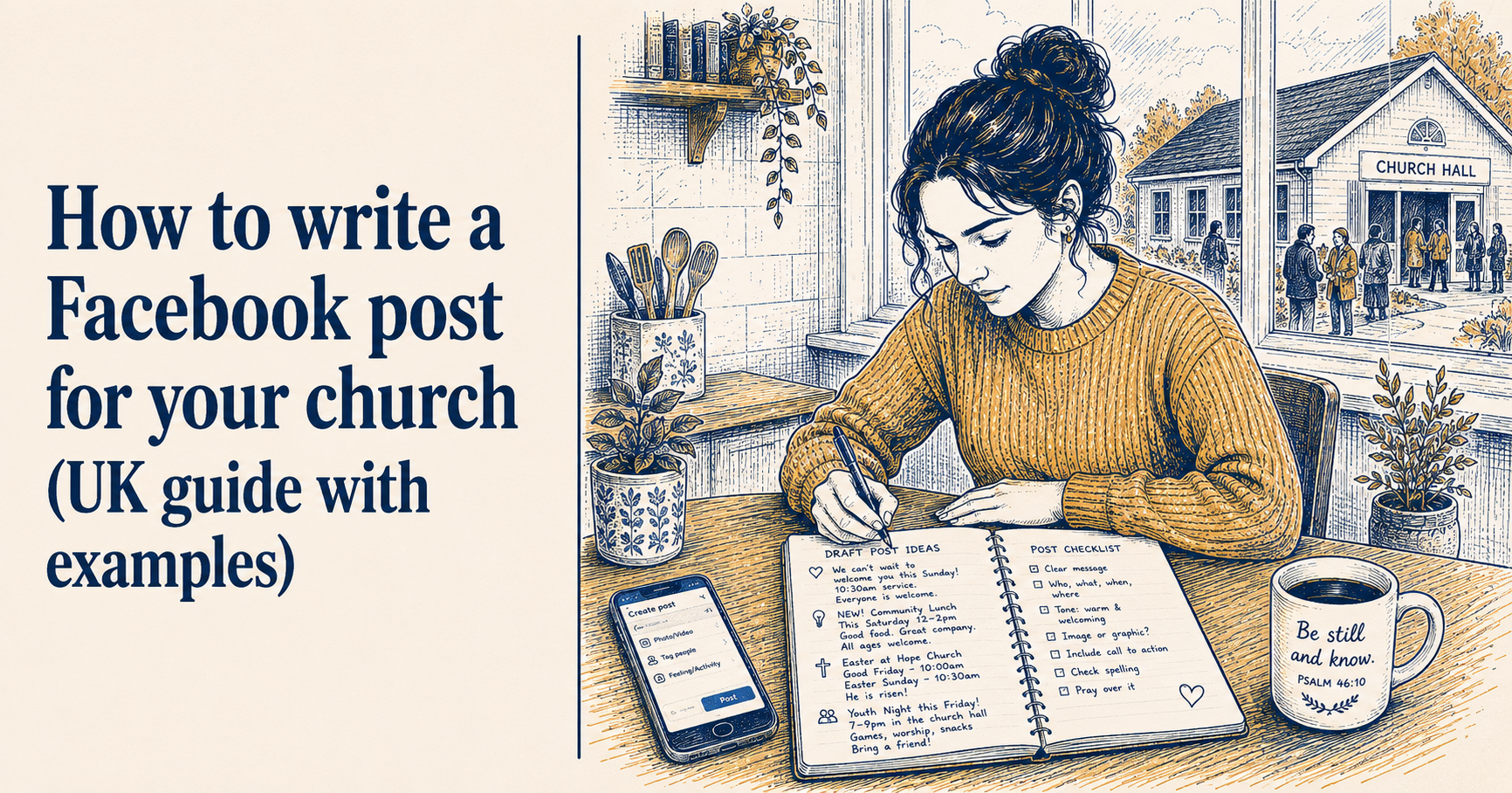
How to write a Facebook post for your church (UK guide with examples)
Facebook is still the most important social media platform for most UK churches. More of your congregation use it than any other platform, more people search it when looking for a local church, and it remains the place where church content gets shared most naturally between people who know each other.
Writing a good Facebook post for a church is not complicated, but it is different from writing for Instagram or a newsletter. Facebook rewards posts that feel genuinely human and locally rooted. It penalises posts that feel corporate, over-produced or like they were written for an audience of thousands rather than a congregation of sixty.
This guide covers the basics, the common mistakes, and some concrete examples of what works.
The basics of a good church Facebook post
Write to one person, not a crowd. The most common mistake in church Facebook posts is writing as if addressing a large audience: “We are pleased to announce that all are welcome to join us for our Harvest Festival celebration.” This is how a press release reads. A post that performs better writes to a single imagined person: “If you haven’t been to a Harvest service before, this Sunday is a good one to start with.”
Lead with something real. The first line of a Facebook post is what appears before the “See more” cut-off. That first line needs to earn the click. “Join us for our Sunday service at 10.30am” does not earn it. “We sang the same hymn this Sunday that this congregation sang exactly forty years ago. Here’s why it still matters.” does.
Keep it shorter than you think. On Facebook, most people are scrolling. A post that is four sentences long and ends with a clear point will outperform a post that is twelve sentences long every time. If you need more space, use it sparingly.
One thought per post. Resist the urge to announce five things in one post. A service time, a prayer request, an event reminder and a Bible verse do not belong in the same update. Four separate posts, each with one clear purpose, will reach more people and be remembered better than one post trying to cover everything.
Ask a question occasionally. Facebook’s algorithm rewards posts that generate comments. A post that ends with a genuine, easy-to-answer question will reach more people than one that does not. “What is your favourite hymn for this time of year?” is not sophisticated social media strategy, but it works.
What to post and when
Service times and changes. Always worth a post when anything changes: a different start time, a combined service, a change of venue. Even for a regular service, a Sunday morning reminder post at 8-9am consistently performs well because people are deciding whether to come right now.
Event announcements. Post twice: once the week before as the main announcement, once the day before as a reminder. Keep both short. The first post can include more detail. The reminder post should contain only the essentials: what, when, where.
Photos from services and events. Real photos of real people in your church are your most valuable content. They perform better than graphics, they get more shares, and they show prospective visitors what your congregation actually looks like. Post them the same day or the day after while the moment is still relevant.
Bible verses and reflections. A short verse with two or three sentences of thought performs consistently well on church Facebook pages. Keep the reflection personal and honest rather than instructional. “This verse has stayed with me this week because…” lands differently from “This verse teaches us that…”
Pastoral and community moments. A request for prayer for someone in the congregation (with their permission), a note of thanks from a community project, a mention of something happening in your local area that your church is involved in. These posts remind your followers that your church is genuinely connected to real people and real places.
Common mistakes
Starting with “We”. “We are delighted to invite you to…” is how institutions communicate. Most posts that start with “We” would land better starting with something else. Try beginning with a question, a statement, a specific detail, or the word “This” or “If”.
Announcing rather than inviting. “Our Harvest Festival service will take place on Sunday 5th October at 10.30am” is an announcement. “If you’ve never been to a Harvest service, this is a good excuse to come along on Sunday” is an invitation. The second version is slightly more effective because it addresses the reader’s possible hesitation.
Over-explaining. Facebook posts do not need to cover every possible question a reader might have. Include a link or a contact for anyone who wants more detail, and trust people to use it.
Posting the same thing every week. “Join us for Sunday service at 10.30am, all welcome” is worth posting, but if it is exactly the same every week, people stop seeing it. Vary it. Use a different photo. Reference what the sermon series is about this week. Note something specific happening that Sunday.
Graphics with too much text. Facebook reduces the reach of images that are more than 20% text. If you are posting a graphic, keep the text on it minimal and put the detail in the post caption instead.
Examples
Here are some concrete examples showing the difference between a weaker and a stronger version of the same post.
Service announcement:
Weaker: “Join us this Sunday for our morning service at 10.30am. All are welcome.”
Stronger: “This Sunday we’re starting a new series looking at the book of Ruth. If you’ve never read it, it’s shorter than you think and more surprising than you’d expect. 10.30am as usual - see you there.”
Event announcement:
Weaker: “We are hosting a Harvest Supper on Friday 3rd October at 7pm in the church hall. Tickets are £8 and available from the welcome desk.”
Stronger: “Our Harvest Supper is on Friday - and last year it sold out. Tickets are £8 from the welcome desk or reply here and we’ll put some aside for you.”
Bible verse post:
Weaker: “Isaiah 40:31 - ‘But those who hope in the Lord will renew their strength. They will soar on wings like eagles.’ Amen.”
Stronger: “This verse found me at the right moment this week. ‘Those who hope in the Lord will renew their strength.’ If you’re tired right now - and who isn’t - this one is for you. Isaiah 40:31.”
Photo post:
Weaker: “What a wonderful morning at our Family Fun Day! Thank you to everyone who came along and made it such a special occasion.”
Stronger: “Over 80 people came to our Family Fun Day this morning - including quite a few families we hadn’t met before. If that was your first visit, we hope you’ll be back.”
Using AI to write church Facebook posts
AI caption writers have become genuinely useful for church social media volunteers, not as a replacement for human judgement but as a starting point that removes the blank page problem.
The most effective approach is to describe what you want to say - the event, the verse, the moment - and let the AI produce a draft, then edit it to sound like your church. The draft will rarely be right first time, but it is usually faster to edit a decent draft than to start from nothing.
ChurchReach has an AI caption writer built in, trained to understand the context of UK church life. You can also set your church’s voice and tone in the settings, so the suggestions start from a baseline that already sounds like you rather than a generic social media account. Try it as part of a free trial at churchreach.co.uk.