
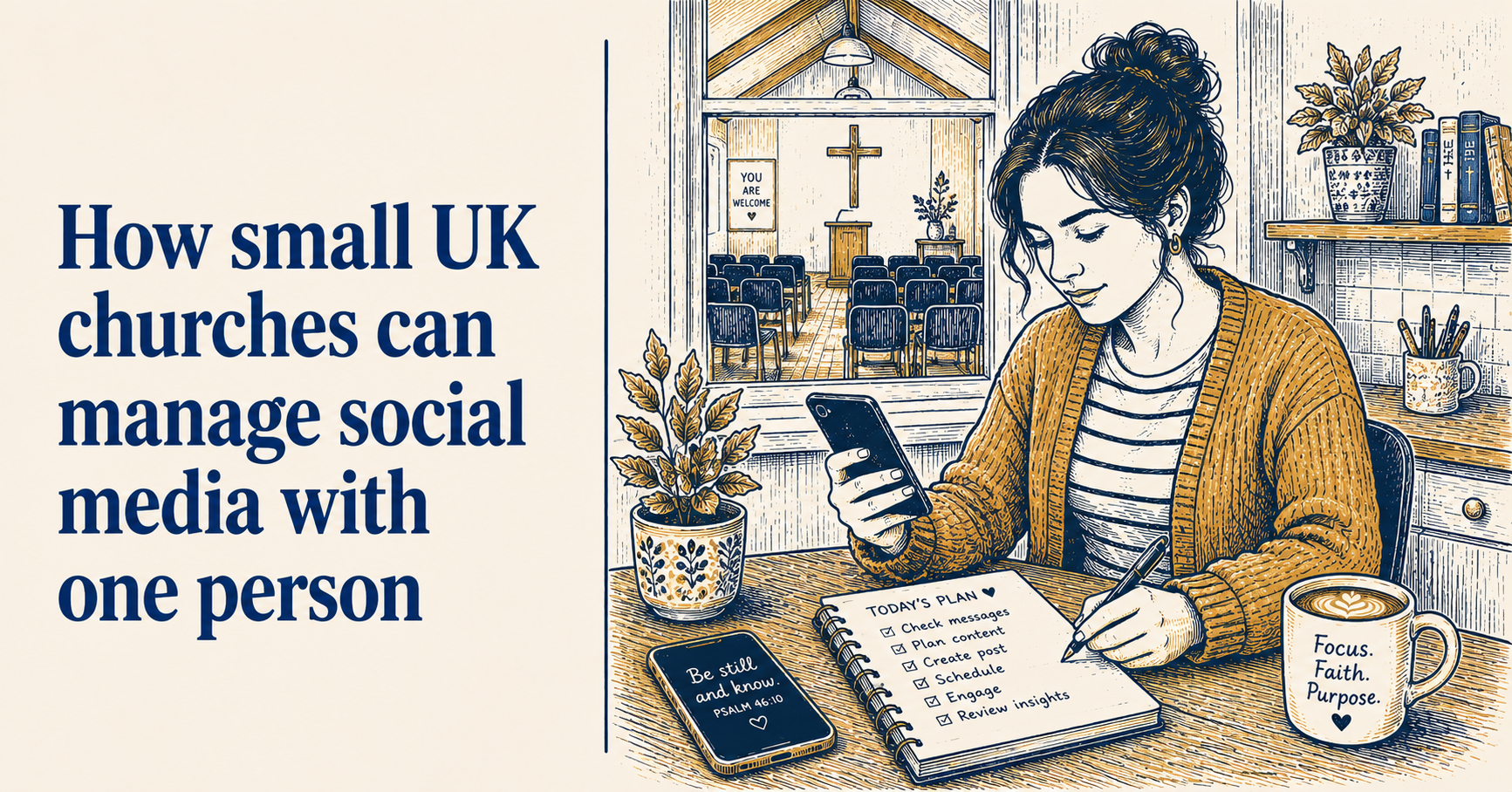
How small UK churches can manage social media with one person
Small churches face a particular version of the social media problem. The larger churches in your area may have a communications team, a budget for design tools, and someone whose job it is to think about this stuff. You have one volunteer, probably doing this in their spare time, probably without a clear brief, and probably wondering whether it is worth the effort at all.
It is worth the effort. But the way you approach it needs to reflect the reality of your situation rather than the standards set by churches ten times your size.
This guide is specifically for small UK congregations, which for these purposes means anywhere from twenty to around a hundred regular attenders. The advice is different from what you will read in most social media guides because the constraints are different.
Start with one platform and do it well
The most common mistake small churches make with social media is spreading themselves across multiple platforms and doing none of them well. A neglected Instagram account and a Facebook page that has not been updated for six weeks does more damage to your church’s online presence than having no Instagram at all.
Pick one platform and commit to it properly before adding anything else. For most small UK churches that platform is Facebook. Your congregation is almost certainly already there, and it is where people in your area are most likely to search when they are looking for a local church.
Once your Facebook page is consistently active and well-maintained, then consider whether Instagram adds anything. For many small churches it will not, at least not at first.
Three posts a week is enough
There is no rule that says you need to post every day. For a small church with one volunteer, three posts a week is a perfectly sustainable and respectable posting frequency. The important thing is consistency rather than volume.
Three posts a week covers the essentials: a Sunday service reminder or recap, a practical update about something happening at the church, and something reflective or devotional. That is a rhythm most volunteers can maintain without it taking over their week.
The way to make three posts a week feel manageable is to batch them. Set aside an hour on Monday morning or Sunday afternoon, plan the week’s posts, write the captions, find or take the photos, and schedule them all to go out at the right times. Then leave it alone until the following week. How to schedule church social media posts covers exactly how to do this.
Use what you already have
Small churches often assume they do not have enough happening to fill a social media account. This is almost never true. What they are missing is not content but a habit of noticing content.
If your church records its sermons and posts them to YouTube, you have a source of weekly material that most volunteers never think to use. A quote from Sunday’s sermon, a short clip, a question the message raised: any of these make good posts and take five minutes to produce.
Photos from any church gathering, however small and informal, are among the most engaging content a church can post. Ten people having lunch after a service is worth a photo. A birthday being celebrated in the church hall is worth a photo. The flowers someone arranged for Sunday morning are worth a photo.
A Bible verse with two sentences of personal reflection takes ten minutes to write and reliably reaches beyond your immediate followers when people share it.
None of this requires creative talent or significant time. It requires noticing what is already there.
Keep your graphics simple and consistent
A small church does not need elaborate graphics. What it needs is consistency: the same fonts, the same colours, the same general look applied across everything it posts. That consistency is what makes a social media presence look intentional rather than assembled from whatever was available that week.
Set up one template for each type of content you post regularly: a service announcement template, an event template, a Bible verse template. Apply your church’s colours and font to each one. Then every time you need a graphic, you open the relevant template, update the details, and you are done.
The best tools for church social media graphics covers the practical options, including free ones that work well for small churches with no design budget.
Let go of the things that do not matter for your size
Large churches worry about posting frequency analytics, optimal posting times, A/B testing captions, and engagement rate benchmarks. These things genuinely matter when you are trying to reach thousands of people.
For a small church with a congregation of forty, they do not matter. What matters is whether your congregation knows what is happening this week, and whether a person searching for a local church can find you and get a sense of what you are like.
Measure your social media against those two standards, not against the metrics designed for organisations operating at a completely different scale.
The handover problem
One of the most damaging things that happens to small church social media accounts is that the volunteer who runs them leaves and nobody knows the login details, what the posting rhythm was, or which accounts even exist.
If you are the person currently managing your church’s social media, write down what you do while you are still doing it. A single document covering the platforms you manage, where the login details are, what a typical week’s posting looks like, and any recurring content you produce. This takes an hour to write and can save the next volunteer months of confusion.
If your church uses ChurchReach, your scheduling and templates stay in the account rather than on one person’s phone or laptop, which makes handovers significantly simpler. How to manage your church’s social media as a volunteer has more on building a system that survives a change of volunteer.
What good looks like for a small church
A small church with one volunteer managing social media should not be trying to look like a large church with a communications team. It should look like what it is: a real, local congregation of real people, doing real things together.
Genuine photos of actual people. Honest reflections rather than polished copy. Service times that are up to date. Events that are announced with enough notice for people to plan around them. A tone that sounds like the person who wrote it.
That is all it needs to be. And it is achievable with one volunteer and an hour a week.
ChurchReach was built with small UK churches in mind. Scheduling, templates for UK occasions, and tools that make one-person social media management genuinely sustainable. Start a free trial at churchreach.co.uk.